
Why You Should Take Breaks in the Office
 How often do you take breaks at the office? It may seem like a pointless question, but skipping your breaks at the office is an easy way to burn out fast. Imagine this: you’re working on a major project with a deadline right around the corner, but you keep running into roadblock after roadblock. Stress, anxiety, and frustration are growing, looming right over our shoulders with no relief in sight. Not even after we clock out and head home, because all we can think about is work. It’s times like these when breaks become a necessity, not just for the sake of productivity, but for the sake of your own personal wellbeing.
What are the benefits of taking breaks at the office?
Why exactly should you take at least one short break during your workday? Research has found that taking breaks during the workday offers a wide variety of benefits for both your mind and body. Here are a few:
Reduced Stress
It’s no secret that stress can hinder your ability to perform well in the office. In fact, stress has been linked to a myriad of health problems, including high blood pressure, heart problems, and increased susceptibility to diabetes and cancer. It can also cause mental health problems, including irritability, hopelessness, and brain fog.
Not to worry, though. Taking breaks while at work has been proven to reduce stress throughout the day. It’s suggested that when you begin to feel overwhelmed by stress, it’s best to take a short break to give your mind a rest from the source of your stress.
Boosted Physical Well-being:
Taking breaks during the workday can also provide plenty of benefits to your physical health. According to the American Heart Association, sedentary jobs have increased 83% since 1950. Meanwhile, the average office employee sits for an alarming 15 hours every day. An inactive lifestyle is detrimental to our health, with the Mayo Clinic finding that “those who sat for more than eight hours a day with no physical activity had a risk of dying similar to the risks of dying posed by obesity and smoking.” Humans didn’t evolve to sit in front of a screen for hours on end.
Taking breaks throughout the workday provides the perfect opportunity to introduce more activity back into your life. From a quick stretching session to a walk around your building’s perimeter, the possibilities to get active during a break are endless. Anything to get you out of your seat and moving! The Mayo Clinic claims that even “leisurely movement” can have profound impacts on our health.
Increased Motivation and Productivity:
Research suggests that working on a task for prolonged amounts of time decreases your ability to perform well on the task. This phenomenon may be linked to the process by which your brain eventually ignores a stimulus after extended exposure to it. For example, you become accustomed to the smell of something after being exposed to its scent for a long time. Similar things may happen to actual thoughts. And if a task eventually disappears from your mind, then your motivation and productivity to work on it will also vanish!
Consequently, getting some space away from a project after working on it for a while will give your brain some much-needed space. It could clear any roadblocks impeding your progress and enable you to bring a fresh perspective to the task, rejuvenating your motivation and boosting your productivity!
What can I do during my work break?
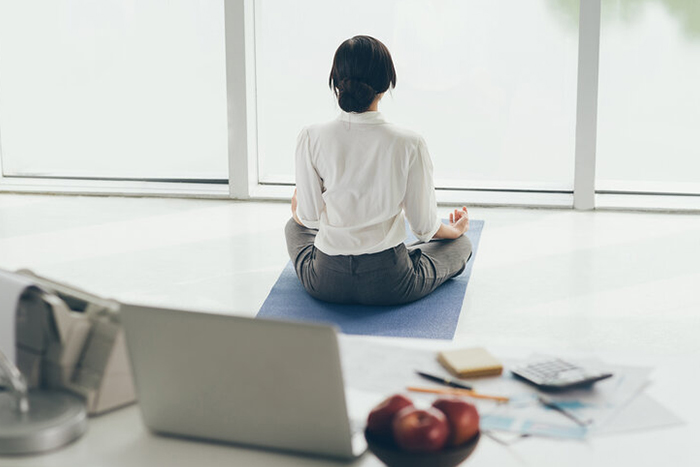
We’ve explored the many benefits of taking breaks at the office, but what exactly should you be doing on your break? Here are some ideas:
Exercise
As mentioned earlier, breaks are the perfect time to get active and burn some calories! Some other ideas include light calisthenics (body weight squats, push-ups, jumping jacks) and even busting a move to your favorite song (with some headphones on, of course)!
Take some deep breaths
The benefits of deep breathing are bountiful. Deep breathing helps induce the relaxation response, the process that helps us get out of the stress response. In other words, that “fight or flight” response that is brought about by many of our modern stressors.
Explore your creativity
There’s no reason why your breaks shouldn’t be fun, as well! Getting creative on your break by drawing some doodles or writing a few lines of poetry can be a chance to let the more artistic side of your brain take the reins, while the analytical side takes a break. It might even spark some new ideas for whatever project you were working on!
Check in with your surroundings:
Using your break to truly connect with the environment around you could get you out of your head and back in the present moment. Try to notice something new about your office space that you never noticed before, be it an interesting light fixture or the buzz of the street outside.
Connect with your coworkers
Getting social on your break is a great way to connect with your coworkers, just make sure that they are on break and want to chat as well! Strong relationships essential to building an office community, so using a break to discuss current events or your weekend plans with your colleagues could be an important step to strengthening your team as a whole.
Go outside
It’s been theorized that humans have an innate desire to connect with nature, an idea known as the biophilia hypothesis. Using your break to step outside and reconnect with the great outdoors has been proven to have many benefits, including enhanced physical and mental well-being.
Office furniture can facilitate restful breaks
Did you know that your office furniture and design can help encourage employees to take restful breaks? Creating a workspace that genuinely encourages rest requires moving away from the “desk and task chair” mentality. Furniture needs to contrast with its active working environment in both ergonomics and aesthetics. Here are the types of furniture that best facilitate restorative breaks:
Reclined and Deep-Seated Seating
Standard office chairs keep the body at a 90-degree angle, which maintains a state of “readiness.” For true rest, the body needs to shift its weight.
-
Lounge Chairs with Ottomans: These allow employees to elevate their feet, which improves circulation and physically signals a break from “task mode.”
-
Bean Bags or Soft Pods: These provide a “cocoon” effect. The lack of a rigid structure allows the body to fully relax and can reduce sensory overstimulation.
Privacy and Acoustic Solutions
Employees often won’t rest if they feel they are being watched or if the environment is too loud.
-
High-Back Acoustic Sofas: These have tall, padded sides and backs that create a visual and auditory “fort,” dampening office noise and providing a sense of psychological safety.
-
Sleep Pods or Napping Cabins: For high-pressure environments, dedicated pods provide a darkened, quiet space for short power naps (15–20 minutes), which can significantly restore cognitive function.
Movement-Based “Active” Rest
Not all rest is sedentary. Some employees find mental recovery through gentle, rhythmic movement.
-
Indoor Swings or Hanging Chairs: The gentle rocking motion is naturally soothing to the nervous system and encourages a playful, creative mindset.
-
Rocking Chairs: Modern ergonomic rockers provide a rhythmic motion that can lower heart rates and help staff decompress after intense meetings.
Communal and “Cafe-Style” Furniture
Socializing can be a form of rest by shifting the brain from “deep work” to “social connection.”
-
Large Communal Tables: These allow employees to engage with coworkers away from their desks, and encourage mental detachment from tasks.
-
Modular Sectionals: These can be rearranged to accommodate different group sizes, making the break area feel more like a living room than a corporate space.
Taking a few short breaks during your workday yields a range of benefits, from improving your overall well-being to sparking creativity. Your office’s break room is an important space to give employees an area to relax. And here at Facility Solutions Plus, we have a wide range of products to ensure that your break room helps your employees rest and recharge.
Contact us for a free office consultation!